

Oper8 and S&techs Partnership
Oper8 Global Group and S&techs Partner to Build AI and Cloud-ready Data Centresacross APAC ‘Built by S&Techs, powered by Oper8
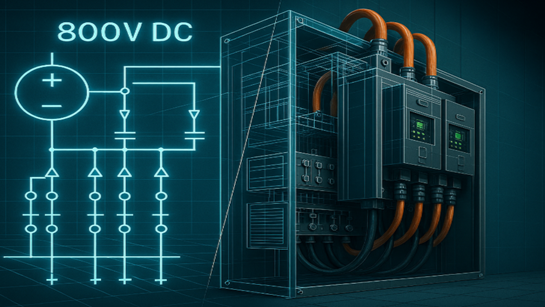
I’ve seen many discussions via LinkedIn focusing on the familiar AC power chain in Data Centre power distribution ; HV utility feeds, generators, UPS topologies, LV switchboards, and PDUs etc…useful, but clearly rooted in yesterday’s design assumptions. As AI workloads surge and rack‑level power densities break past legacy limits, the conversation needs to shift. The next frontier is high‑voltage DC, particularly 800 V DC, where efficiency and scalability align with the realities of AI‑scale compute. Recent advances in HV silicon‑carbide power electronics and commercially available 800V class conversion hardware have removed earlier DC constraints, positioning 800V DC distribution as a technically robust response to Hyperscale AI power demands.
Conversion stages and architectures. Traditional 230/400 V AC systems rely on multiple conversion steps from HV AC to LV AC, then to rectified DC, and finally to point‑of‑load regulation. An 800V DC system collapses this chain by centralising or localising a single high voltage rectification stage and distributing DC directly to the racks. This reduces electrical room footprints, simplifies the power path, and improves overall efficiency. Integration of energy storage directly onto the DC bus becomes more straightforward, enabling DC coupled UPS and renewable interfaces.
Busbar sizing and topology. Lower current at 800V DC enables smaller busbars, fewer parallel runs, and reduced electromechanical forces during faults. This simplifies mechanical design and reduces material use. AC architectures carry operational constraints that become more pronounced at high power and maintaining 2N redundancy requires phase‑synchronised transfer between feeds, which introduces switching transients and inrush events that must be absorbed by upstream breakers and downstream PFC. AC systems also depend on precise phase alignment for seamless changeover, and fault‑clearance times are limited by the zero‑crossing behaviour of the waveform. The DC architecture supports more flexible topologies, including row level DC busways, rack side conversion cabinets, or in rack DC spines. Once a topology is selected, uniformity across the facility improves installation and operational consistency.
Capex impact. An 800V DC architecture reduces current compared with 230/400V AC delivery, allowing smaller conductors, lighter containment, and simpler mechanical structures, reducing the overall copper and installation burden of the distribution system. The trade‑off is higher‑specification power electronics, as 800 V rectifiers and converters require advanced semiconductor devices and more sophisticated protection. Although these components cost more per kilowatt than AC‑fed rectifiers, the overall capital profile shifts toward fewer conversion stages and a leaner distribution network, often resulting in a broadly neutral or slightly favourable capex position.
Opex impact. End‑to‑end efficiency improves as 800V DC eliminates several AC‑DC and DC‑DC stages inherent in 230/400V AC systems. Higher‑voltage distribution also reduces conductor (I²R) losses, lowering electrical waste and cooling demand. Maintenance benefits from fewer conversion components and a simpler power chain, though early adoption requires specialised training and spares. Over time, operational expenditure trends downward due to improved efficiency and reduced component count.
Thermal envelope and cooling. Higher electrical efficiency also reduces waste heat, easing the load on cooling systems and improving overall thermal performance. At the rack level, 800V DC supports very high-density compute without the extreme conductor sizes required under AC delivery. The remaining thermal challenge shifts to concentrated hotspots around high-power DC‑DC modules. The result is a more compact but more thermally efficient power‑delivery environment.
Adoption. NVIDIA is driving an industry transition toward 800 V DC rack-level power distribution. Its Kyber architecture, together with ecosystem partners, is establishing the associated converter, protection, and energy storage technologies required for deployment. STMicroelectronics has demonstrated validated 800V rack power hardware in collaboration with NVIDIA, enabling 12kW power modules operating at efficiencies above 98%. Schneider Electric is developing an 800V DC sidecar architecture capable of supplying 1.2MW racks for forthcoming NVIDIA GPU platforms. Others are jointly advancing engineering‑ready 800 V DC designs, and although public disclosures from hyperscale operators do not yet confirm adoption or pilot programs, industry sources indicate that such systems are already being incorporated into next‑generation designs.
– Graham Keeble
Oper8 Global Group and S&techs Partner to Build AI and Cloud-ready Data Centresacross APAC ‘Built by S&Techs, powered by Oper8
